
Optimizing Line Haul and Last-Mile: Resilient Supply Chains for E‑Commerce Growth
On the existing logistics landscape, the operational concern of delivery economics has become a boardroom priority. Formerly treated as a cost center, the argument over carrier rates and speedy order fulfilment is now a key business imperative, directly influencing revenue, customer acquisition, and loyalty. With shifts in customer expectations and e-commerce norms, same-day and next-day delivery options – offered as premium add-ons by some brands – are turning into a baseline requirement.
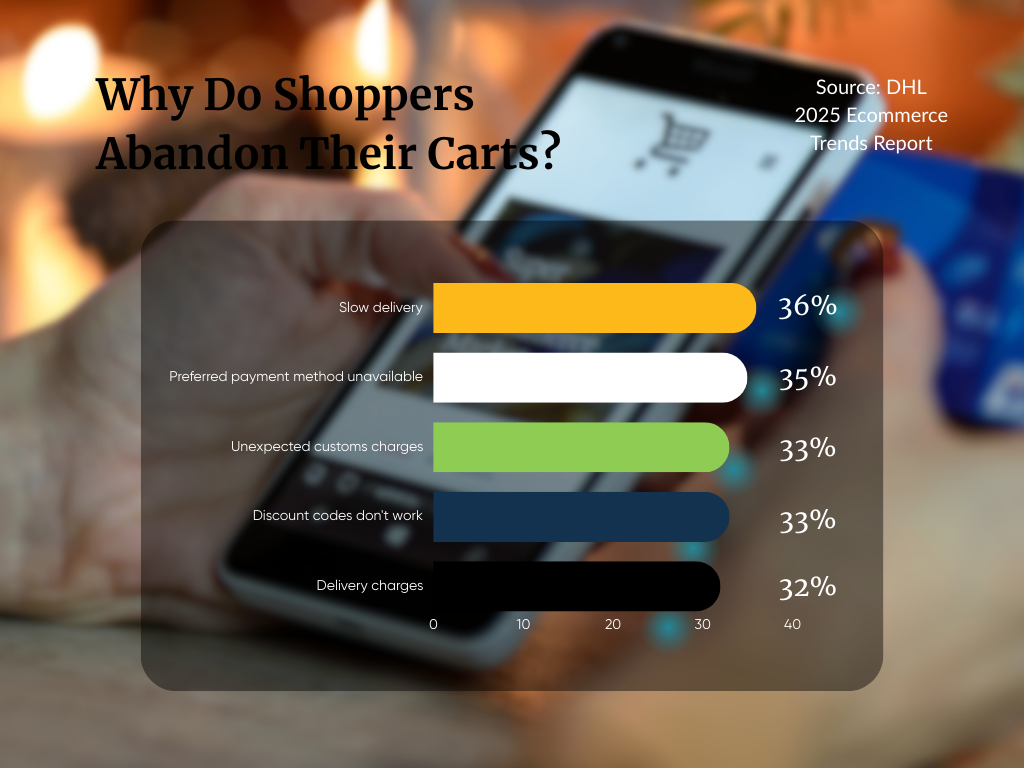
According to a recent DHL survey, 36% of shoppers abandon their carts due to slow delivery – a behavior directly linked to conversion loss and revenue leakage in online shopping.
Another study from 2025 reveals that globally, 56% of consumers aged 18-34 want same-day delivery, and retailers offering this service get a larger share of the market. Buyers check delivery options on multiple platforms before completing a transaction. Competitive offerings from retail giant Amazon and quick-commerce platforms have normalized near-instant gratification, especially for products in certain categories: groceries, pharmaceuticals, and electronics.
For logistics leaders, these trends imply that optimal supply chain management (SCM) is at the nexus of customer loyalty, competitive edge, and margin performance, and these factors demand attention at the C-suite table.
Factoring Supply Chain Volatility into the New Operating Model
Besides rising customer expectations, unpredictable market conditions have also brought delivery speed and cost into SCM on the boardroom agenda. As the operating environment continues to change, logistics leaders must continuously optimize their processes to handle disruptions, routine changes, and sudden changes. Variability is a norm, and the forces reflecting this reality are:
- Intensified demand and supply fluctuations: While historical trends show that Apple brings out a new iPhone every September (and it sells like hot cakes), who knows it might launch a model at some other point in time in a year? The same uncertainty applies to other consumer goods. Promotion-led spikes, seasonal surges, and restructuring across channels imply volume patterns are short-lived and uneven. Traditional forecasting models cannot accurately predict demand and sales.
- Input-cost instability and capacity constraints: Fuel, labor, capacity premiums, and urban congestion fees swing operating costs from quarter to quarter or month to month. European logistics employers have recently faced substantial wage inflation and driver shortages. Collective agreements and minimum wage increases have pushed up labor costs while the pool of qualified drivers continues to shrink. So, even if the demand is stable, a rise in input costs forces re-evaluation of pricing and routing levers.
- Evolving regulations: Trade tariffs and compliance complexity intensify operational risk across regions, goods categories, and temperature-sensitive products. Varying customs, labor, and environmental rules bring random friction that can cascade through the chain.
When persistent variability is a factor influencing supply chains, network architecture, capacity planning, and customer experience strategies, plans need to remain agile and resilient to any change in conditions.
Value Chain View: How Cost and Service Risks Emerge
In volatile environments, a mistake logistics companies often make is optimizing individual legs of their networks in isolation. When costs seem controlled locally, risks and inefficiency can still surface elsewhere. An end-to-end value chain view reveals the sources of margin leakage and service failure.
- First-mile inefficiencies stem from weak pickup discipline, uneven vendor bases, and low shipment readiness. They create delays that cascade downstream.
- Line haul involves a large cost pool, driven by network design, capacity planning, mode mix, load factors, and corridor choices. Sortation has a multiplier effect. Any throughput constraints or poor automation design lead to delays and higher handling costs across the distribution grid.
- The last mile, while smaller in absolute terms, still influences customer experience directly. It carries disproportionate risks of density, rider productivity, and reverse logistics.
To address these issues, CXOs must view their logistics network as a single economic system, where decisions in one leg must be assessed for their downstream costs, risks, and service impacts.
Line Haul Optimization: The Hidden Margin Lever
Line haul is managed as a transport cost but is actually a structural margin lever. A hub-and-spoke network is a good choice for stable, high-consolidation environments because it maximizes asset utilization and simplifies control. On the downside, it can increase transit time and create dependency on central hubs, causing delays or disruptions to ripple across the network. Mesh or hybrid networks perform better on dense, time-sensitive corridors, reducing touchpoints and improving speed. However, they require stronger planning and controls than the hub-and-spoke model.
In addition to network choices, corridor prioritization is critical for line haul optimization. High-volume and service-critical lanes should be engineered for speed, redundancy, and utilization. Long-tail routes can be managed with flexible capacity, partner mix, and service commitments to avoid over-engineering costs. Mode mix decision – surface versus air, FTL versus PTL – must be evaluated for their impact on cut-offs and downstream productivity, not just per-kilometer cost.
Finally, consistent load factor improvement, consolidation, and route discipline deliver scalable gains. When designed deliberately, line-haul stops become a lever that shapes network economics end-to-end rather than a cost to squeeze.
Driving First- and Last-Mile Optimization
First- and last-mile operations in the supply chain are crucial to the customer experience but also difficult to manage. The solution is micro-clustering and dynamic routing to improve drop density, minimize empty miles, and stabilize rider productivity in environments with swinging demand. All small gains at this stage cumulatively benefit the enterprise.
And how to improve delivery promise design? Companies need to plan cut-off times, delivery slots, and pricing tiers to sync customer expectations with network realities and avoid forcing premium execution on every order.
Returns and reverse logistics must also be treated as a designed flow. Well-defined pickup rules, consolidation of reverse movements, and early disposition decisions prevent returns from eroding margins while upholding customer trust.
The Tech Spine for Visibility, Control, and Prediction
Digitalization is now the spine of complex logistics networks. Tracking the real-time movement of goods across nodes, partners, and modes helps detect issues early and manage exceptions before disruptions inflate costs or spoil the customer experience. Control towers should facilitate both reporting and decision-making by enabling teams to intervene in a timely manner as conditions change.
Besides constant visibility through monitoring apps, an AI-based predictive analytics platform helps to understand demand and shape capacity planning. By anticipating volume surges, order fulfilment constraints, and service risks, operators can proactively adjust routing, mode mix, and partner allocation. The aim of deploying new tools and technologies in SCM is to make the process more controlled, predictive, efficient, and resilient.
Resilience as a Built-In Capability
In volatile logistics environments, networks have to be built to absorb shocks rather than just maintain average-day performance benchmarks. This calls for multi-node, multi-partner, and multi-mode playbooks that support rapid rerouting when capacity, cost, or service conditions shift.
Resilient operators stress-test SLAs against peak demand, weather events, regulatory changes, and partner failures. Their strategic hedge is a contingency network design featuring alternate corridors, backup partners, and flexible operating modes. At the CXO level, resilience is planned optionality that protects service and margins under pressure.
A Playbook and Proof: A 90-Day Supply Chain Optimization Program
At Practus, we have found that a 3-month SCM optimization program can help logistics leaders achieve smarter warehouse processing and positively impact line haul and last-mile operations. It starts with diagnostics that assess lane-level P&L, service variability, and capacity constraints to reveal the true cost and risk drivers.
The next step is network and operating design, defining priority corridors, partner mix, delivery promises, and the supporting tech spine. The final phase emphasizes execution—pilots on critical lanes, phased scale-up, and clear governance to ensure discipline and accountability.
This approach delivered tangible returns for a major logistics company: we applied network discipline, warehouse and last-mile process optimization, and strong control mechanisms to improve delivery performance (15%), increase average client order volumes (20%), and reduce operational leakage, including fraud.
The takeaway for CXOs: Executing end-to-end structured, time-bound optimization boosts both speed and economics without sacrificing control.
What CXOs Should Track Monthly
As delivery expectations rise and uncertainty persists, CXOs need a focused monthly scorecard. It has to track network efficiency metrics, including cost per shipment, utilization, and on-time performance. There should also be a record of resilience indicators, such as recovery time, SLA stability, and variance absorption, across corridors. Together, these signs reveal whether the network is merely adjusted for averages or dynamically prepared to perform under pressure.